Sunday, 27 March 2011

Ben's Built-in Braai - Chapter 4

Three days into the English spring and we had been blessed with days of defiant sunshine. Ben and Tersia had finished painting and paving around their braai and saw it fit to invite us and some other friends around to celebrate.

Ben excelled himself and yet again proved how rich and diverse every day South African outdoor cooking actually is. Armed with a bag of lumpwood charcoal and a load of beautifully seasoned English ash we were in for a treat that none of us could have predicted.

In the true traditional way, he started with a selection of sausages, in this case there were three; venison, champagne and pork, and pork chorizo (my favorite), all sourced from our mutual friend and local butcher Clint at Denshams in Witney. Topped up with some corn on the cob and salad, this also served as the main meal for the small army of children who had been occupying themselves building a den of some sort.

King prawns marinated in garlic and lemon juice followed, served with a lemon mayonnaise and cooked on Ben's new Jamie Oliver perforated grilling plate.


Ben had both the braii and the Weber going as the main course included an intensely flavoured pork fillet filled with a herby smoked oyster stuffing that needed to be quickly baked in a hot kettle barbeque.


His venison loin chops were melt in your mouth stuff and were topped with a warm, sticky, home made barbeque sauce. Most bizzarely, the main course was also served with cheese, tomato and onion toasties, gently cooked over the dwindling embers in the braai tool. This was an unexpected treat and one I would highly recommend.


A generous salad of mixed leaves, avocado and olives made the perfect accompaniment to the main meal, both refreshing and robust.

This was a beautiful example of using fire at its best. Grilling sausages at a fairly high temperature over hardwood embers initially, followed by marinated prawns, then the venison chops cooked more gently, and finally the toasties. The Weber did its own separate job and sorted out the quickly roasted stuffed pork loin along side.

Tersia's radioactive waste pudding was another surprise. Crunchy green minty stuff chopped up and laid over the top of 'Tennis' biscuits (yes, and I don't know where that name came from from either, please enlighten me if you do). I've never had anything like this before. Intensely sweet and distinctively flavoured, I can see why South Africans hanker to re-live this experience. Well done and thank you to both of you.


Sunday, 20 March 2011

Haunch of Venison in the Weber

Wrapped in streaky bacon and stuffed with mushrooms, thyme and creme fraische, the 4kg haunch was enought to feed a small army. I used a third of it a a main course for a dinner party for 8 and so had plenty of leftovers.

On this occasion we opted for a very classic menu:

- Smoked salmon plate (discovered in 'Falling Cloudberries' by Tessa Kiros)
- Roast venison haunch with a red wine jus, roast potatoes and swede, steamed julienne carrots and purple sprouting broccoli
-Freshly made pavlova topped with whipped cream, strawberries, raspberries and blueberries

I ordered the venison from my friend and local butcher at Denshams in Witney. I asked for it to be 'tunnel boned' and hoped he might have some caul fat for me to wrap it in. Unfortunately not, so I bought some streaky bacon instead, just enough to cover the top and sides of the joint. He came up with an idea as he was serving me and presented a large fatty membrane from a beef flank. I decided to keep the bacon as well to put around the venison before wrapping the whole thing in the membrane.

Anxious not to risk disappointing my guests, I also bought a new meat thermometer as our old one had come apart some time ago.

FOR THE RED WINE JUS

You can make this in advance and then add the pan juices at the end.

- 1 bottle of red wine for cooking
- 1 red onion, finely chopped
- 1 medium carrot, finely chopped
- 1 stick of celery, finely chopped
- 1/2 litre of chicken stock
- 1 knob of butter
- 1 tablespoon of olive oil
- 1 tablespoon of double cream

Saute the vegetables in the butter and olive oil until soft, then add the wine and simmer it down to at least halve the volume. Add the chicken stock, and reduce it again. Knorr make a superb chicken stock powder labelled 'Chicken Powder' or 'Bot Ga' available in tins from most Chinese supermarkets. I affectionately call it 'powdered chickens' because I'm sure that's what it is! It tastes nothing like any chicken stock cube I've every tried.

Ideally you want to have a decent cup full of jus before straining it and adding the cream to bind it together. These quantities will happily do 8 serves. Allow a good hour or more to make a good jus and keep an eye on it. If you like, you can thicken the sauce with a basic roux but I prefer it just as it comes.

FOR THE MUSHROOM, HERB & CREME FRAISCHE STUFFING

- 200g of mushrooms (any sort) finely chopped
- 1/2 red onion finely chopped
- 1 tablespoon of chopped fresh thyme leaves
- 1 big dollop of of creme fraische
- salt and pepper to taste
- 1 tablespoon of olive oil
- 1 knob of butter


Saute the onion in the olive oil and butter until soft before adding the mushroom and seasoning. Cook out all the moisture and allow to cool completely. Fold in the creme fraische and chopped thyme and set aside.

Venison is very lean so it needs to have fats introduced to help it along during the cooking. This stuffing is great as it provides fat in the centre of the meat to supplement the streaky bacon on the outside.

THE VENISON

- Venison haunch (I had a whole thigh from a 25kg animal)
- Mushroom, herb and creme fraische stuffing (above)
- 8-10 rashers of streaky bacon
- kitchen string


Using a tea spoon, push the stuffing into the bone cavity of the venison with a spoon. Then, with two pieces of string tie both ends of the haunch to give it a nice round shape. Use a third piece of string to close up the ends of the haunch lengthways, but not too tightly or the joint will end out mis-shaped.

Drape the rashers of streaky bacon over the joint to provide plenty of basting fat for the roasting. On this occasion I then wrapped the whole thing in the fatty flank membrane and secured it with a few more pieces of string.

Place the venison on a narrow baking dish in the Weber to retain the juices for basting. I used my trusty pyrex dish which was barely big enough for this one.

Depending on how you like your venison done, a joint of this size will take up to 3 hours to cook in a Weber. I used lumpwood charcoal, a chimney starter full at the beginning (split into two indirect fires) and I topped up the fires twice with a couple of handfuls more charcoal during the cooking. This was also a good opportunity to baste the roast and to let the charcoal re-oxegenate.

Concerned about having the roast ready on time for my guests, I kept checking the inside temperature with the thermometer. Two hours in and the temperature was below the 'rare' scale and seemed to be climbing ever so slowly. I also noticed that the membrane covering was preventing the meat from browning so I made a last minute decision to remove it so I could give the venison a proper basting and hopefully accelerate the cooking for my hungry guests. Miraculously, the roast turned out perfectly, soft and moist on the inside and with loads of nice crispy bits on the outside. 65-70 degrees C at the centre of the roast is what you need to achieve.

Carve the meat thinly and serve with a generous helping of the jus. This is melt-in-your-mouth stuff. Unbelievably tender and intensely flavoured.

FOR THE SMOKED SALMON PLATE (for 8)

Eye food at its best. Meticulous preparation, intense colours, diverse flavours, the perfect appetiser to get the evening going.

- 200g Smoked salmon
- 2 small jars of Salmon caviar
- 24 cocktail Blinis
- 4 hard boiled eggs, white and yolks separated and finely chopped
- Large tablespoon of fresh dill, finely chopped
- 1/2 red onion, finely chopped
- 2 small lemons, filleted as below

To fillet the lemons, slice the top and bottom off of each lemon and sit it flat on the chopping board. Then remove the skin and pith with a small knife. Carefully cut out each segment by running the point of the knife down each side, remove any pips and put the segments in a small dish for use later. Squeeze any remaining juice out of the lemon 'skeleton' and keep it to drizzle over the salmon. Filleting a lemon was a new experience. It took half an hour to remove the fillets of two lemons, but hey, it was beautiful day and I did it sitting at the table bathed in sun in the conservatory.

Chop the red onion into super fine pieces and cover them in water with 1/2 teaspoon of salt. Let them soak for 1/2 hour or so before straining and rinsing them thoroughly.

Carefully assemble the ingredients on a plate and dress the salmon and caviar with the lemon juice. Warm the blinis in the oven for 5 minutes before serving.


FOR THE PAVLOVA (serves up to 12)

- 8 egg whites
- 2/3 cup of castor sugar
- 1 teaspoon of cornflour
- Vanilla essence
- 1/2 pt of whipping cream
- berries for the topping

Pre-heat the oven to 180 deg C. Beat the egg white on a high speed in a mixing bowl until softly stiff. Slowly add the castor sugar, cornflour and vanilla essence on a lower speed until thick and glossy. Using a spatula, put the pavlova mix out onto a flat baking tray lined with grease proof paper. Shape it into a round about 25cm in diameter and make a shallow well on top.

Bake it at 180 degrees for 20 minutes, and then at 120 degrees for a further hour. Remove from the oven and allow to cool completely.

Just before serving, whip the cream, spread it over the top and dress with the berries.

I kept the left over egg yolks in the fridge and used them the following day to make fresh custard.


Sunday, 27 February 2011

Aussie Damper Bread on a Stick - Chapter 4

The end of February looms, and still no fire food opportunities. Thankfully a weekend away staying with family in south Wales saved the day. What could be more perfect than the kids and their cousins cooking their own pudding over an open fire.

I knocked up a batch of dough about an hour before and wrapped it in cling film. 2 cups of self-raising flour, 3/4 a cup of milk and a bit of sea salt is all it takes for five decent sized dampers. I mixed the ingredients together in a bowl first with a knife and then with my hands. It felt a bit sticky, so I just added a sprinkling more flour.


By the time the dough was needed it had already started to grow and felt beautifully light and airy. I went into the garden with a torch and a large cherry tree had kindly left enough decent sized twigs on the lawn so the five kids would have one each. I used my little finger as a guide for the thickness.

Meanwhile my brother-in-law Jared had started a cracking cooking fire in the outdoor brazier with smallish sized wood so it wouldn't take too long to become embers.


I scrubbed the sticks in the sink to get the mud off them, scraped the ends clean (not really necessary) and worked the dough on to the ends. After 15 minutes of rotating the dampers over the embers, they had more than doubled in size and smelled delightful. I was slightly worried that the embers wouldn't last long enough, but Jared's cooking fire proved to be perfect. There was no danger that the dampers would burn and the cooking finished off at a nice gentle temperature.


My niece, Amber, said the smell reminded her of scones. Not surprising really, scones on a stick cooked over an open fire is what they are. The ingredients are the same.

The kids and cousins loaded them up with butter, jam, Nutella, you name it. They loved them and I fulfilled my 'at least monthly' obligation to cook over fire. Everyone's a winner.


All the time our dear Kitty had filmed the experience with her video camera. Once she's done her editing homework you will be able to check it out on YouTube. Fire Food's first...
Damper bread

Sunday, 23 January 2011

A Moroccan Menu

January is always a Fire Food challenge. Fortunately, we had planned a dinner party for a few lovely friends and after trawling our library of recipe books found a main course that would define the Moroccan theme for the evening.

Then began the research. Choosing a theme is great because it focusses the mind and provides a framework for deciding the menu. Hankering for some warmer weather and desperate to burn some charcoal, a Mediterranean/North African meal just felt right.

Moroccan food culture is wonderfully ritualised and steeped in tradition. Loads of lovingly prepared courses are designed to delight and comfort the guests. Sometimes dozens of tiny courses are served, usually local dishes and prepared over a period of days. Bread making takes on an almost religious role, families use their own traditional recipes and the children take the loaves to communal ovens for baking.


Our UK lifestyle required a practical adaptation to the Moroccan approach. We planned the meal around three courses, where the Moroccans may have turned the same meal into six or seven:

FIRST COURSE: Moroccan spiced chicken skewers with parsley, almond and feta, home made unleavened bread and mint yoghurt

MAIN COURSE: Lamb with anchovy and harissa, sprouting broccoli and slow roasted tomatoes

DESSERT: Cinnamon oranges

The skewers and unleavened bread would be cooked over charcoal on the Weber to keep the smoke out of the kitchen, and the lamb was to go in the oven.

The starter is from a recipe we found at waitrose.com, the main course came from the 'Autumn' section of a fabulous cook book "A Year in My Kitchen" by Skye Gyngell, and the desert recipe was discovered at eHow.com under "Easy Moroccan Desserts" .


I got back from food shopping some time after 2pm and loads of various elements needed preparing. I was lucky to have just enough time before my guests arrived at eight. As usual, I prepared a plan. It began by toasting and grinding the spice mixes by hand, one for the kebabs and one for the harissa. Several large red peppers were blackened under the grill and their skin removed (for the harissa). 6 cloves of garlic were then crushed for the chicken rub and harrisa, and another two cut into slivers for the lamb.

The slow roasted tomatoes would take 3-4 hours at 100 degress, so they went in the oven. Medium sized red ripe vine tomatoes were halved, sprinkled with a bit of salt and sugar and laid out, cut side up, on a baking dish.


To feed eight, I bought two small legs of lamb. I was worried that one large leg might not do and was hoping for some leftovers anyhow. I removed the bone from each leg and 'butterflied' the lamb. I laid the lamb skin side up in a large baking dish before poking holes every 3-4cm with a paring knife and pushing a sliver of garlic and half an anchovy fillet into each one. I brushed the lamb with melted butter, seasoned it with lots of pepper and a bit of salt, covered it with foil and put it aside at room temperature.

The recipes required coriander, mint and parsley, so I chopped them finely and put them in sealed containers in the fridge.

The spice rub for the chicken skewer starter is a delightful mixture of coriander seeds, cumin seeds, cinnamon, cloves, saffron, turmeric, garlic, salt, lemon zest and olive oil. The recipe called for boned chicken thighs, but I opted to use breast instead. My charcoal fire was going to be hot and the risk was that thigh may have been undercooked when burnt on the outside. Breast takes minutes to cook and should be just lightly charred on the outside.

Following the quantities in the waitrose.com recipe, there was an abundance of the spice rub. I used four chicken breasts for 8 small skewers, and each cube of breast was thoroughly coated into what became an intensely aromoatic crust after just a few minutes of char-grilling. I used metal skewers (even soaked bamboo skewers would not survive this kind of heat) and put coriander leaves between each cube of chicken.


The parsley, almond and feta salad came out very differently to what the recipe intended. Firstly, after visiting two major supermarkets and the fruit and veg stall at our local market, flat leaf parsley was nowhere to be found. Curly parsley only. I prepared all of the ingredients, crumbled the feta, toasted and chopped the almonds, chopped the dates and added the parsley. Possibly something to do with the type of feta I used, but mixing it all together, however gently created something that resembled more of a dip than an salad. Nonetheless, the flavour was great and it would still look good on the mezze style plate for the starter.


For the unleavened bread I used my favourite method. Basically an Indian chapatti recipe, but using plain white flour instead of wholemeal, and olive oil instead of ghee. I made the dough a couple of hours before the guests arrived, wrapped it in foil and left it at room temperature. I made enough dough for 4 small flat breads (1 cup of flour) so each starter plate could be served with two quarter pieces.

The minted yoghurt to be served with the starter was basically a Greek tsatsiki recipe, using drained grated cucumber, a mixture of fresh and dried mint, crushed garlic, a squeeze of lemon and a bit of olive oil. I made this in advance and put it in the fridge to chill.

I prepared the harissa in the food processor, being careful not to put in too much chilli, covered it with cling film and left it room temperature. Meanwhile, my lovely wife prepared the cinnamon oranges and put them in the fridge.

Finally, I washed and trimmed the broccoli, prepared a light, herby stock with a bit of saffron added for the cous cous (to be prepared just before serving).

With the guests arriving at eight, I had just enough time to clear up the kitchen and put some decent clothes on. I would put lamb in the oven and light the charcoal once the guests arrived and hoped that the rest of the timing would all fall into place.

By 8:15, they had all arrived. After we provided everyone with a drink and made the necessary introductions, the lamb went into the preheated oven and I lit the Weber chimney starter. This meant 20 minutes before I could grill the kebabs and make the bread, and an hour before we could serve the main course. The recommended cooking time for the lamb was 40 minutes plus resting, 20 minutes under foil and 20 minutes to brown the skin side.


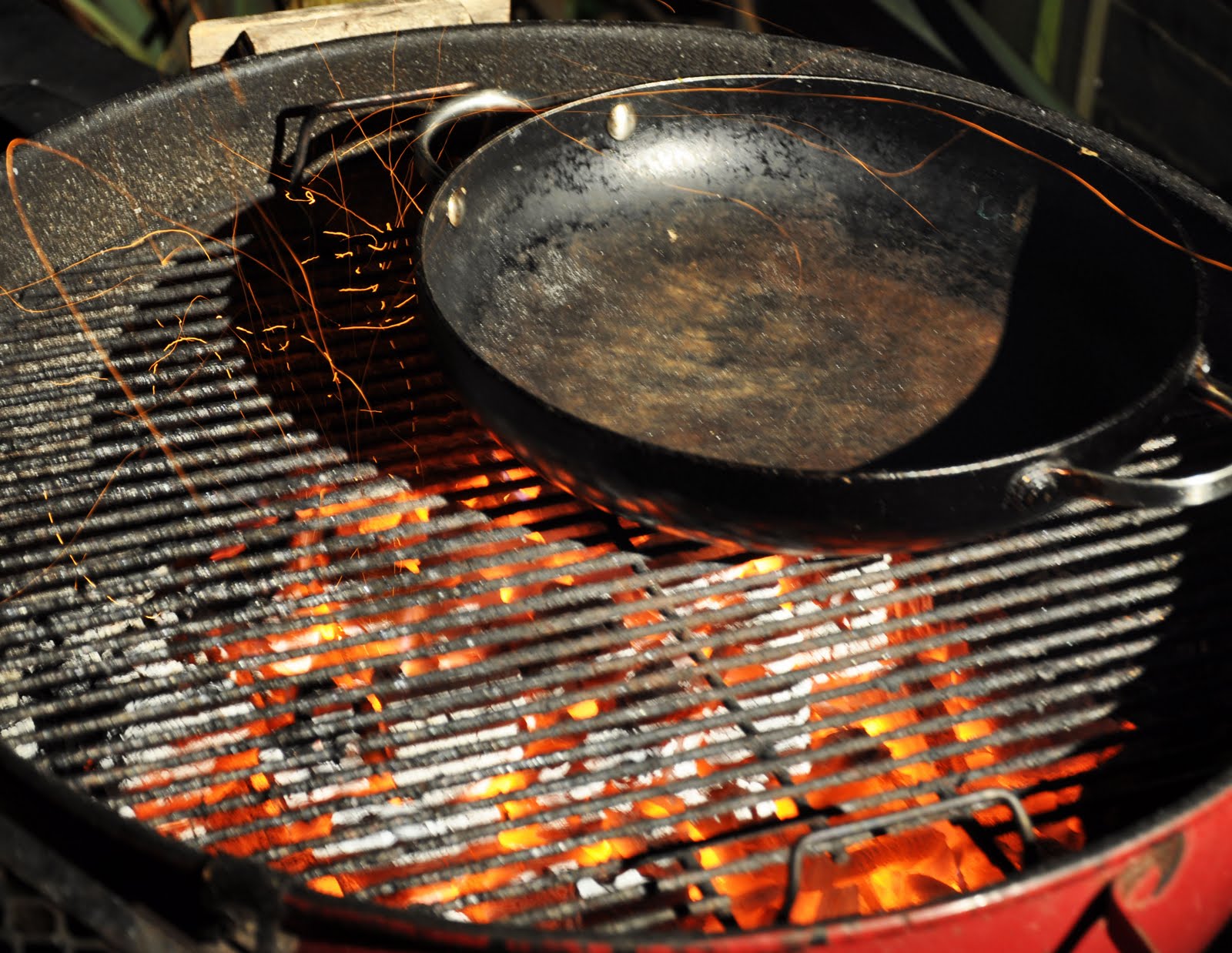
Whilst waiting for the charcoal fire to mature, I rolled out the four flat breads and wrapped them in a tea towel to stop them drying out. As planned the coals were searingly hot in good time so on went the paella pan to heat up for the bread, on on went the skewers. I was constantly moving them about to stop them burning whilst cooking the flat bread and wrapped them in a cloth to keep them warm. The whole thing took just a few minutes, five at the most, and the starter was ready to serve.

I covered the skewers with foil in the hot pan I had used for the bread to keep them warm back in the kitchen whilst the feta, parsley and almond "salad" and tsatsiki were spooned out. I finished off the plate with the hot skewers, pieces of flat bread, a lemon wedge, a single caper berry and a sprinkling of fresh coriander leaves over the chicken.


Needless to say, it went down a treat. The sweet and sour provided by the feta and dates, refreshment from the yoghurt, lemon and mint, and the intense complex flavour of the marinated chicken worked for me. The starter was sufficiently substantial to bridge the 30 minutes or so before the main course would be ready.

For the main course, all there was left to do was steam the broccoli, prepare the cous cous, carve the lamb and serve it up. Using my just sharpened carbon steel Opinel knife, I carved the lamb into thin slices across the grain of the muscle and returned them to the baking dish to keep warm under foil. I put the dish on the hob with a gentle flame to keep the pan juices hot for serving.

The sliced lamb, brocolli, pan juices and harissa were served on to warmed plates and garnished with two roasted tomatoes.


The lamb was not pink (I had left it in a bit longer), but very tender and full of flavour with the anchovy fillets and garlic slivers providing extra little bursts along the way. The harissa? Well I was impressed. Complex flavours from the spice mix, just a bit of bite from the red chilli and all that elevated freshness from the coriander leaves. Unfortunately, I had overcooked the broccoli, which was a shame, but it was all eaten all the same.

After a reasonable break and plenty more wine, my lovely wife served up the pre-prepared cinnamon oranges. Wow, nothing like I have ever had before. Juicy chunks of orange mixed with slivered almonds, finely chopped dates, lemon juice, ground cinnamon and a bit of castor sugar. The refreshing, cleansing effect was a perfect finish to the meal.

Wednesday, 29 December 2010

Christmas Turkey on the Weber - Chapter 4

SUB-ZERO OUTDOOR COOKING - CHRISTMAS 2010


After a week of snow and freezing temperatures, Christmas day promised to be dry, sunny and very cold. And that it was. The temperature fell to minus ten degrees C overnight and peaked at an invigorating minus four sometime during the daylight hours.

We planned to have our Christmas dinner at around 6pm, so the cooking was done in the afternoon. I was slightly anxious as I wasn't sure how to compensate for the extreme cold (no insulation in a Weber!). To avoid any fire starting delays I deployed the Weber Chimney Starter and loaded it to the top with good quality, dry lumpwood charcoal that I had been storing in the house. I had a total of about 4kg and was starting to worry whether it would be enough as it was seriously cold outside.

We went to a Christmas service in the morning, and then by the time we had done a round of present opening and had a bit of lunch, I lit the chimney starter at about 1:15pm. We had a 8.5kg (17 pound) turkey plus a layer of stuffing between the breast and skin. I'd looked up the cooking time for the bird weight at 3hrs 10mins plus a bit extra for the cold weather (I guessed a mere 10 minutes). As the stuffing is to protect the breast, it doesn't affect the cooking time of the thigh so I made no further adjustments.

The cooking and checking timetable worked out something like this:

13:15 hrs - Lit chimney starter
13:40 hrs - Turkey in Weber
14:00 hrs - Checked turkey/fire and took photo (top). Sizzling nice and gently, skin starting to brown, anxiety decreasing
15:05 hrs - Fire a bit low, so added a bit of charcoal to both fires
15:50 hrs - Checked, all ok
16:30 hrs - Added a bit more fuel (total fuel used approx 3-3.5kg)
17:00 hrs - Removed turkey and covered with foil (total cooking time 3 hrs 20 mins)

I let the turkey rest for about 45 minutes before removing an entire breast with its stuffing layer. This was enough to feed six hearty appetites and was on the table at 6pm as planned. Our vegetarian daughter had all the trimmings served with a vegetable stock and garlic gravy I made separately.

I served the turkey with the traditional accompaniments of stuffing, giblet gravy, pigs in blankets, roasted potatoes and parsnips, steamed carrots, brussel sprouts and home made bread sauce.

This left us with an entire breast (for turkey pie which we had yesterday), and the legs, thighs and wings for turkey lasagne. The carcass is currently simmering away in the kitchen and will provide us with some good stock for the lasagne and what's left will go in the freezer for soups, sauces and gravies.


For the original post have a look at Perfect Christmas Turkey on the Weber where you will find loads more detail, photos and links to other recipes.

Saturday, 4 December 2010

Christmas Turkey on the Weber - Chapter 3

THE STUFFING

To complement my original article Perfect Christmas Turkey on the Weber and the recently posted photo gallery from our 2009 Christmas turkey, this is an ideal stuffing to layer between the breast and the skin. Don't worry if you make too much, it can be rolled into little balls and baked separately.

You can make the stuffing and stuff the turkey on Christmas eve and leave it in the fridge for cooking the next day. This really takes the sting out of kitchen duties when the kids are all desperate to sit around and open their presents.

I use a whole tube of good quality sausage meat, with about the same volume of fresh breadcrumbs (made in the food processor). then add the juice and grated rind of a whole lemon and lime, and plenty of seasoning. The stuffing just needs to be mixed well before working it between the skin and the breast. The stuffing layer can be at least an inch thick. It protects the breast from drying out beautifully and is a treat in itself.

Friday, 3 December 2010

Christmas Turkey on the Weber - Chapter 2

PHOTO GALLERY

For the full story, method and cooking times, have a look at my original article, Perfect Christmas Turkey on the Weber. These photos are from our 2009 Christmas turkey experience at home in Oxfordshire (another 20 pounder) and will hopefully help to entice you further towards striking that match!


Related Posts with Thumbnails