Friday, 29 June 2012

Still Life with Potjie


They say a picture tells a thousand words, and to me, this one certainly does. First there's the story of my lovely new potjie (that's pronounced 'poy-kee' by the way).

My South African foodie mate Ben bought it for me for my recent birthday. I can't tell you how thrilled I was. He's recently moved to Herefordshire, so he ordered it from an obscure village post office-cum-purveyor of all things South African, not far from us here in Oxfordshire. He'd given me some advance warning and all we had to do was wait for his cheque to clear and I'd get the OK to go and pick it up. I go right past the shop each time I go into Oxford so I arranged to get it on my way back on the afternoon I was given the all clear.

To make it a bit more fun I thought I'd travel on my son's Vespa. He's touring Asia on his gap year and he encouraged me to get my motorcycle training sorted out so I could make use of it while he's away. So that I did and I've been scooting around on this thing for some time now, and I absolutely love it.

I called in to the South African shop to collect my gift, announced the reason for my visit, and the three South African guys working in the shop greeted me with a very nicely sung 'Happy Birthday to You......'. They seemed as thrilled as I was and all came out to help me secure my new gift to the rear rack on the scooter. They put it in a box and I had two decent straps to hold it on. It took a good fifteen minutes of trying different ways until we were all happy it was secure. I asked one of the guys to take this photo using my phone so I could send it Ben and Tersia to say thanks.


The journey back was about 6 or 7 miles through a couple of villages and mainly on country roads. About two miles from home, I was belting along a busy A road at about 50 mph when I heard this almighty crashing noise behind me. I glanced in the mirror and there it was. I could see the box and lid in the middle of the road about 100 yards behind me. There was no hard shoulder, so I pulled up as close to the edge of the road as possible and walked to survey the damage. I felt gutted. I got to the box (empty) and lid (still in one piece) but there was no sign of my potjie. I trawled the dense bushes on the side of the road as I made my way back to the bike and couldn't see it anywhere. When I got to the bike, there it was! Miraculously dangling from the rack on the strap that had been looped through the eye where the handle attaches. It was hanging barely an inch off the road. I can not describe the sense of relief I felt.

I reminded myself that there were lorries flying by in both directions and I should not really be lingering around. It was when I was re-securing the pot in the box that I realised the mistake us three blokes had made. The three legged pot was in a cardboard box, and what had happened was the legs had punctured the bottom of the box, and the pot then dropped just far enough to slacken the tension on the straps.

Even with traffic flying by in both directions, I worked out that the best way was to put the pot in the box upside down. Not that I will ever need to use that knowledge again. Had the chunky cast iron pot hit the road at 50 mph I'd have been collecting in two or three pieces. It's still a miracle that the lid survived. It has a small scratch which will be there forever to remind me of the experience.


I got home, rang Ben to tell him the story and took his instructions on seasoning my new miracle potjie. Casting iron is a greasy dirty process and leaves nasty residues that need removing before the pot can be used. The process involved boiling water in the pot, washing it, boiling more water, washing it again, then cooking something fatty in it for the first time. He suggested bacon, and so my pot was christened and is now nicely seasoned.

Now back to my still life (and this is 750 words so far by the way), because it's not just about the potjie.

This blog is really a bit of a desperate round up for the month of June, and it is my first ever blog without any recipes. My self imposed discipline of writing at least one article per month has been stressing me so much that I just had to drop everything and get it done.

Through the window in the photo is my trusty old Weber. We had a dinner party recently that would have been a perfect opportunity for a good story. I so wanted to make pork belly on my garden rotisserie, but was defeated by our lovely English weather. My fall back was to do the pork belly in the Weber, twice cooked. Can you believe I over fueled the fire on the second cooking, and the fat in the baking dish actually ignited. The pork was black around the edges and underneath and 10 people were on their way. It looked beyond rescue. Somehow I managed to stay calm (unlike my wife) and reviewed the disaster. The crackling still looked ok which was a start. So I carefully removed the charred edges and divided the pork into 10 servings (albeit a bit smaller than intended). I swear, you'd never have known and inside, the pork was perfect.

In the photo, the Weber is missing something... yes it's the handle that should be on the lid. I still haven't fixed it, not since mentioning it in a post last November.

There are two more stories my picture has to tell. My lovely chilli plants on the window cill, planted from seed back in March and now starting to fruit. There is another pot just opposite and they look so lovely. At the same time I planted some herbs which are in my little plastic greenhouse on the deck. Secondly, it's the lack of sun. This month has been dire as far as the weather is concerned, so there have been few opportunities for outdoor cooking. Wind and rain. Relentless.


Work/life pressure has kept me off the blog radar a bit too much this month, and I would like to apologise to my favourite food bloggers whose blogs I've been unable to keep up with. The loss is mine and I will be doing something about it!

So my picture has now said 1,168 words. The myth has become true.

Coriander blossom and tomato leaves
Tomato flowers
and basil in abundance

Monday, 21 May 2012

Monkfish Kebabs

Cooked over charcoal embers


Planning a dinner party for pesco-vegetarian guests was a bit of a treat. We probably don't eat enough fish in this household so this was a perfect excuse to do something about it. Fire was to play a part too as it looked like we were in for some dry (relief!) and mild weather for a change. Having had the wettest April since records began, May hadn't been much better, so we were determined to make the most of it.

During the previous manic working week, I had been thinking about the meal in the background but it wasn't until the Saturday morning, the day of the dinner party, that I was able to plan it properly. I started by grabbing a dozen or so of my favourite cookbooks and sat in bed checking all the indexes for fish recipies ideal for the barbecue. It wasn't too long before I was seduced by a photograph in Jamies Kitchen of some gorgeous looking fish kebabs. I checked out the recipe and it got even better. Marinated in ginger, lemon, chilli, mint, yogurt, garlic and turmeric, these were guaranteed to be a winner.

Grinding the herbs and spices in the yogurt


Jamie's kebabs also had boiled new potatoes and were skewered onto sprigs of rosemary. I omitted the potatoes as I was already serving roasted chipped potatoes with the main course. The rosemary sprigs were very pretty in the photo, but at the end of the day they'd just get burnt to a cinder, so I thought my rosemary was best left on the bush, and I used stainless steel skewers instead. I was also particularly taken by the shaved zucchini 'zig-zags' in the photo. A nice bit of colour and creative presentation I thought.

The zucchini 'zig zags' were made with a veggie peeler


Monkfish is one of the few fish that is firm enough to be skewered and barbecued. Unlike most fish, it doesn't flake apart when cooked. Jamie's recipe (and the seductive photo) is available on line as I found later when I Googled 'monkfish kebabs' before writing this article, just to see what else was out there. Lo and behold, Jaimie's recipe came up at position no. 1.

I had some frozen king prawns in the freezer, so they went on the barbecue too


Once the menu was decided I made a frantic call to my local Waitrose to make sure I could actually get hold of some Monkfish. Luckily they had some and put about 800g aside for me. Had they not, I'd have had to make a trip into Oxford for it. And that I would have done.

These little pots worked a treat


My 'Go Anywhere Weber' came out of the garage as it was the perfect size to grill the kebabs without wasting too much fuel. I used fast burning English charcoal as these things would only take about 5-10 minutes to cook.


The first course I've been doing fairly frequently lately since my sister-in-law prepared it for us on a recent visit. Little pots with smoked trout, horseradish, cream cheese and chives served with mini hot Yorkshire puddings. It's great because the pots can be prepared in advance leaving just the Yorkies to be baked before serving. This one also came from a Jamie Oliver book: Jamie's Great Britain.

Our lovely guests, Jo and David


For desert there was home made pavlova, and I even made fresh custard with the left over egg yolks (in the past I've been struggling to think of what to do with them, but from now on it's sorted).


We had a fabulous evening with Jo and David. After the main course, I used the coals left over from the barbecue to start a proper fire with some of my treasured foraged oak branches. We were blessed with a cool, still, dry evening and spent hours chatting around the fire and gazing into the embers.

...chatting around the fire...

... and gazing into the embers.


Sunday, 13 May 2012

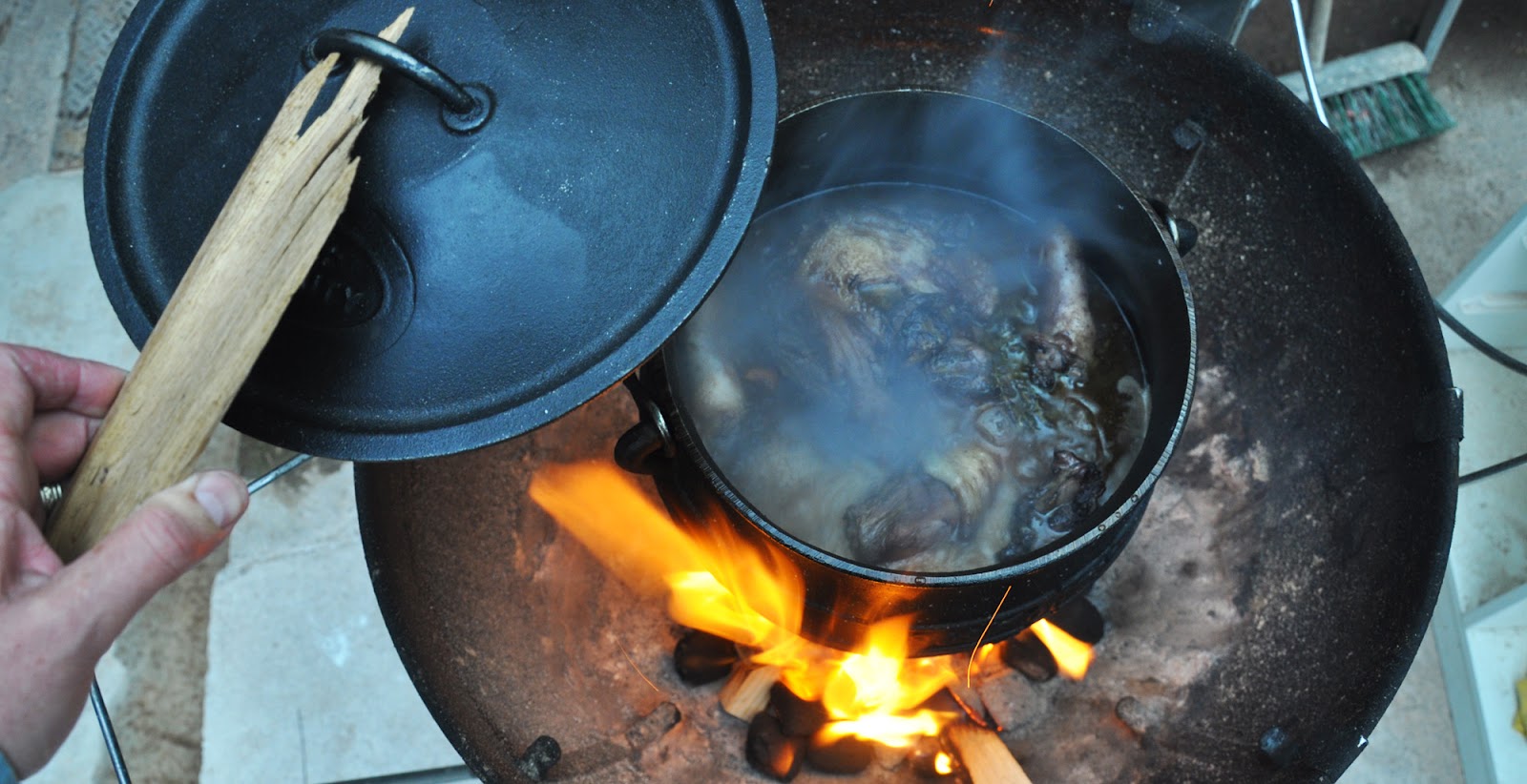
Cockerel au Vin - A Tale of Two Cockerels

I never had the pleasure of meeting Bushman, or his brother for that matter. Well, that was until one of them met the fate of the big black pot. I'd been looking forward to this meal for some time. When my South African foodie friend Ben said he had a 3.5 kg cockerel in the freezer and was saving it for our next visit I felt honoured. Each time we visit he makes such a special effort and this was no exception.

Bushman's brother was nameless for a reason. He was destined for the pot. Bushman however was to meet a bizarre fate of his own. The two brothers were offered to the Van Vuuren family by their local tree surgeon and with five beautiful hens in need of a 'man', they could not resist. The cockerels were delivered, Bushman got the girls, and shortly after was the slaughter. It was a ritualised family event, involving their kids and Ben's wife Tersia as executioner's assistant. I'd been grilling Ben in advance of our visit to his enviable place in Herefordshire as I knew this would be a good story to tell, so he emailed me his own touching and entertaining version of the event (see link below).

Two weeks after Bushman's brother found his new home in the freezer, Ben was decorating their new kitchen and heard a shriek coming from the orchard. Tersia had discovered poor Bushman who had fallen into an old cast iron bath filled with water and had drowned. Miraculously, after some CPR and mouth to mouth (I kid you not), Bushman actually came back to life and started walking around. But his second life was to be an even shorter one. Minutes later he coughed and spluttered his way back to oblivion, and with no hope of return. Ben mercifully finished him off, and he was honoured with a proper family burial and funeral. Unlike his brother.

0 hrs 10 mins
So, back to the coq au vin. This was a big bird and and worthy of one of the most famous French provincial dishes around. The recipe was created for exactly this. 'Coq' in French means cockerel, not chicken yet we have become so used to what is probably 'chicken' au vin. In this context, the extended marination in red wine, garlic and herbs starts to make some sense. It's brown meat all the way, even the breast and can really only be eaten like this, cooked long and slow in a rich and aromatic marinade. The recipe and method is uncannily similar to 'bouffe Bourguignon', right down to the shallots, bay leaf and bacon lardons, as both have the intention of delivering meltingly tender results.

0 hrs 15 mins
Ben researched long and hard and came up with a hybrid of all the best recipes around. He started with the overnight marination in red wine, garlic, thyme, bay and onion, then the high temperature browning off of the cockerel. With the cockerel temporarily removed from the pot, onions, carrots and more thyme were then sauted, and the cockerel returned to the pot with about a litre of stock made from the back bone and wing tips.

1 hr 0 mins
From then it was just time, and lots of it (3-4 hours ideally) on a gentle simmer. Ben sauted the shallots and bacon lardons and added them to the pot about 30 minutes before the end. A handful of fresh thyme, parsley, minced garlic and grated lemon zest before serving and there you have it.

1 hr 25 mins, our amazing seafood starter hits the table
There was more to the meal than the coq of course. Ben amazed us with a seared mixed seafood starter and Tersia prepared some amazing chocolate meringues with Kahlua cream. As always, we had a fabulous time and before long, they'll be coming to us so time to get thinking about what to serve. Fire will be involved. I promise.

All Roads Could Lead to Coq au Vin (by Ben Van Vuuren)

Five lovely ladies (the widows)


3 hrs 30 mins - Totally worth the wait

Monday, 16 April 2012

Spit Roasted Poussin

Marinated in rosé, lemon, garlic, rosemary and dried chilli


 Poussin is not a bird that I cook very often. These tiny chickens are a very special treat and just ideal for the slow sizzle on a spit over charcoal embers. It's a bit like a mini version of the commercial 'Rotisserie' seen all over France; loads of chickens on large spits inticing passers by with their amazing aromas.

This special occasion was a weekend visit by our friends Lynn and Gary who had come up from Eton to stay. The previous weekend we stayed with my sister in law and were treated to roasted poussin, so it seemed the perfect indulgence and an opportunity to do something a bit different on the garden rotisserie.


I bought four poussins, each weighing about 450g which would, at a push, just about sqeeze together on my spit. The marinade made a perfect base for the light rosé wine sauce.


The meal kicked off with potted smoked trout and baby Yorkshire puddings as an entreé (from Jamie's  Great Britain), then the pousin with slow roasted vine tomatoes and a warm salad of green beans, asparagus and wild rice. For dessert, I made a decadent rosewater panna cotta with pink champagne and strawberry jelly.

INGREDIENTS (For the poussin and the rosé sauce)

- Four poussins (1 per person)
- 1 bottle of rosé (1/4 for the marinade, 3/4 for the sauce)
- 8 cloves of garlic (4 whole, 4 crushed)
- 2 lemons
- 2-3 dried red chillies, crumbled
- 2 tbsp of olive oil
- 2 tbsp of finely chopped rosemary
- 1 cup of good quality chicken stock
- 1 onion finely chopped
- 30g butter
- 1 tbsp plain flour

Weber chimney starter


METHOD

Start by marinating the poussins in a large bowl or sealable plastic bag with the wine, oil, grated rind of 2 lemons, the crushed garlic, rosemary, chilli flakes and juice of one of the lemons. The night before in the fridge is ideal, but for no less than 3-4 hours at room temperature at minimum. Before assembling the spit, insert 1/4 of a lemon and a whole clove of garlic into the cavities of each bird. These were on the rotisserie for about two hours. I was using fast burning British charcoal, it was fairly breezy and a chilly ten degrees outside, so regular charcoal top ups were required. (in the oven they would take 45-60 minutes at 180 deg C).

0 hrs 5 mins


1 hr 0 mins


Once the poussins are on the fire (or in the oven), the sauce can be pre-prepared and re-heated just before serving. To make the sauce, melt the butter in a large saucepan and sauté the onions until soft. Add the marinade juices and wine, then reduce down by about 3/4 over a medium heat. Strain the redution through a sieve and allow to cool a little. To finish the sauce, whisk in the flour after it has cooled, then heat gently, whisking constantly. Slowly add the chicken stock as the sauce thickens until you get to your preferred sauce consistency.

2 hrs 0 mins


These little babies were just soooo tasty. Thanks to the long slow sizzle, the meat just fell off the bones and the little fiery kick from the chilli flakes was delightful. They were fun and messy to eat and the carnage left on the plates is now in the stock pot...

Crystalized rose petals for the panna cotta
The decadent rosewater panna cotta - with pink champagne and strawberry jelly

Monday, 2 April 2012

Spit Roasted Pork Belly

Cooked over a charcoal fire


This meal was prepared in honour of a visit from my parents in law from Hertfordshire, and my sister in law and family from south Wales. It's the begining of the Easter school break and our house was the meeting point for two young cousins to go off and spend a few days with their grandparents. It's not often that we are all together at our place so this special event called for some extra special effort.

I had a large piece of pork belly in the freezer that had been sitting waiting for an occasion just like this. It was also the first time I'd put pork belly on my outdoor rotisserie and I couldn't wait to see how it would come out. Intuitively I thought it ought to be ideal. It's the right size and shape and has plenty of skin to crackle up nicely and keep the meat moist on the inside.

The whole meal was a bit of a feast for the ten of us. In addition to the pork belly, I had a whole chicken in the Weber and some quality chipolata sausages along side. In the oven went roast potatoes plus home made balls of bacon and herb stuffing. Steamed carrots and green beans finished of the plates.

I'm a bit of a puritan when it comes to mixing meats and I wouldn't normally serve more than one meat at a time. Pork and chicken, however is a rare exception. The sauce that comes from a combination of pork and chicken stock also works very well.


Having defrosted the pork belly the night before, the first task was to remove the rib bones so I could roll the belly around the spit. I used a small sharp Opinel knife and kept the bones to make a stock for the gravy. I could have easily asked the butcher to do this for me, but at the time I didn't think to. It was fairly easy as it happened, it just took a bit of time.

Like any garden spit roast, you need plenty of time. This one took about 3/4 of an hour of preparation from starting the charcoal fire to assembling the pork belly on the spit. Getting the fire on at the right time is critical. You want the coals to be white hot when the pork goes on and this can take 20-30 minutes depending on the charcoal you are using. I normally focus on getting the charcoal started, and then use that time to prepare the spit. This spit roast was over the coals for three and a half hours.


A few musings on charcoal. I used high density imported lump wood charcoal as it is readily available and has a good burn time. Charcoal, when packaged and transported gets a bit of a hammering and you always get a good quarter or so of the charcoal as tiny bits or powder as a result of this. I do my best to separate the decent sized 'chunks' from the small bits and pieces. The chunks are perfect for starting a hot charcoal fire as the gaps allow plenty of oxygen to get between them. The bits and pieces I then sprinkle over the established coals using a small gardening trowel when it's time to add a bit more fuel.

After the first 20 minutes - Crackling starting nicely


For this spit roast, I used 2 to 2 1/2 kg of chunks at the beginning, and about an hour or so later started adding the small bits to keep the fire just hot enough to maintain a gentle sizzle on the pork. At the beginning, the white hot chunks are pumping heat at about 1000 deg C (1,800 deg F), then this reduces fairly constantly as the charcoal is consumed. After the first hour, the coals had died right down and definitely needed topping up. I added some more sprinklings around the edges every further 30 mins or so to keep the temperature fairly consistant.

After 50 minutes


And now a few musings on my outdoor rotisserie. I bought this almost three years ago in May 2009. It came with a small battery powered motor that takes two large 'D' sized batteries, the type frequently used in torches. Just before writing this article, I trawled through my photos, blogs and notes to work out exactly how many times I have used it since. On average it has been used about four times a year, between April and October. Each use means about 3 to 3 1/2 hours of continuous rotation. The original two batteries are still going, 13 uses and 45 hours later. I still can't believe it and even when I ran it yesterday it wasn't giving any signs of letting up. I've had a pair of batteries on standby since I bought it.

1 hr 15 mins - First topping up of charcoal


PREPARATION TIME: 30 minutes

COOKING TIME: 3 and a half hours

INGREDIENTS (serves 6 as a generous main course):

- Pork belly (de-boned) - approx 30cm x 20 cm x 2 cm thick
- 1 tbsp olive oil
- 1 tsp salt
- 1 large sprig of rosemary

2 hrs 40 mins - Our first guests arrive


METHOD:

First prepare the charcoal fire as above, then rub the pork with olive oil and salt before rolling around the spit with a large sprig of rosemary in the centre. Tie firmly with kitchen string. Arrange the charcoal around the edges so that there is none immediately beneath the meat. Otherwise the dripping fat will ignite and you do not want thick, sooty flames destroying your meal. Place the spit over the hot fire for the initial intense sizzle at the beginning, then after the first 45 mins to an hour when the coals have gone right down, add small amounts of additional fuel regularly to keep the pork at a gentle sizzle.

Carve into thick rounds and serve with a light gravy made from the stock from the bones.

My intuition proved correct. Pork belly is perfect for this type of cooking. The crackling cooks quickly at the beginning, and protects the meat inside to allow it to slow cook beautifully. All in all it was a winner and will definitely grace our table again. And again.

 3 hrs 30 mins - Ready for carving

Monday, 12 March 2012

Spit Roasted Lamb with Caper, Anchovy & Mint Salsa

Cooked over an oak wood fire
Inspired by an unexpectedly sunny and warm Sunday afternoon, I decided it was time to get outside and make some fire.

Our brazier had been stored in the garage since we went away at Christmas, the spit roasting kit was in bits in various kitchen cupboards and up in the garage roof were some beatifully seasoned oak branches that I had foraged last Autumn.

Something, of course was bound to go wrong. A critical piece of the spit roasting kit was not to be found, so in a last minute panic I cobbled together a support for one end of the spit from an old bicycle spanner and small G-clamp. I was determined not to be defeated.

As the spit roast was a fairly last minute decision, I needed to buy the food and get hold of some kitchen string, as mine had run out. I planned to call into a supermarket on the way back from taking our daughter to her drama class in Oxford. I was going to be pushed for time but it seemed the most sensible option. My list was not complicated; lamb leg (on or off the bone), capers, anchovies, fresh mint and a few other essentials whilst I was at it.

Parking in Summertown in Oxford can be hit and miss, so I considered two options. If I could park easily in Summertown, I'd get everything I needed from one or two of the supermarkets there. If not, then I'd head straight back to Witney and get everything I needed from Waitrose in the town centre. Luckily, as I was driving through Summertown, I nabbed a parking bay just as someone was pulling out. Great, time saved already. There are two supermarkets there, a fairly large Co-op and a Marks and Spencer.

I started with the Co-op to grab the essentials and anything else they had that was on my list. Essentials, fine. Capers and anchovies also fine. Mint? Lamb? Kitchen string? Nope. Fortunately M&S was just next door. I headed straight for the fresh produce, picked up two packets of lovely looking mint leaves then headed to the fresh meat section. Nothing. Diced lamb only. Not much good for spit roasting unfortunately. I re-calculated my options and realised that I now had no choice other than to head for the Witney town centre as well. Saving a bit more time I dumped the mint leaves to avoid the busy checkout, and legged it to the car.

The twenty minute or so journey gave me time to calm down a bit and re-plan the rest of my errands. There are two large supermarkets in the Witney town centre, a huge Sainsburys and the Waitrose. There was a fighting chance that everything I needed would be at either of the two. As I passed it first, I pulled in to Sainsburys. Easy parking, a good sign, so hopefully not too packed. I found two very nice packets of lamb leg, off the bone. They would be perfect to 'sandwich' them around the spit. Mint leaves, yes, fine. Now kitchen string? I hunted around the kitchenware area and saw nothing, I hunted for some one to ask and they didn't stock it. In a store the size of a football pitch. Can you believe it.


Waitrose, here I come. And it was the last place I bought kitchen string. Why didn't I just go straight there in the first place? By now I'm kicking myself. Easy parking again, another good sign. I headed straight for the kitchenware section and became immediately confused. The entire section was almost completely empty with a few odds and sods marked down for clearance. Not my day. I found someone to help, and was told that the kitchen ware section was being re-modelled. Great. And kitchen string? Please, I always buy it from here? Sorry, out of stock. I pleaded for to the poor assistant to help me and suggest where, at 3:40pm on a Sunday I might get some? I could try Cargo just opposite I was told. I bolted across the pavement, found someone straight away to ask. Sorry, we don't stock it. We looked at eachother and simultaneously said 'Lakeland'. A few minutes walk away. I was saved. They had some. By now I was at least 45 minutes behind my planned schedule, so we would be eating a little later than usual.

I finally got home. Six shops and about an hour later than planned. I relayed my disaster story to my wife who found it much funnier than I did. But, I had made it back, and now it was time to play. I grabbed a much needed cold beer, prepared and lit the fire, and retreated to the kitchen to sort out the spit roast.


INGREDIENTS:

For the spit roast:

- Lamb leg, off the bone
- 4-5 anchovy fillets
- 4-5 peeled and squashed garlic cloves
- 1 dollop of butter
- Mint leaves, roughly broken up
- Salt and pepper
- Olive oil to rub on the outside
- Kitchen string (!)

For the salsa:

- Large handful of mint leaves, finely chopped
- 1 tbsp drained capers, finely chopped
- 1 medium tomato, finely chopped
- 4-5 anchovy fillets, finely chopped
- 1 spring onion, finley chopped
- 2 tbs good olive oil
- 1 tbsp wine vinegar
- 1 tsp of fine demerara sugar
- Salt and pepper


METHOD:

For the spit roast (can also be done in a oven or Weber):

Place the capers, anchovies, garlic, butter and mint on the inside of the lamb. Roll the lamb around the spit and secure tightly with kitchen string. Rub the outside with olive oil and season generously with salt. I added a few potatoes to either ends of the spit after giving them a 5 minute head start in the microwave.

Spit roast gently for about two hours. I started the fire with oak pieces, let it burn down and then occasionally topped it up with a few sprinklings of those charcoal dreggs that accumulate at the bottom of the bag.

Alternatively, prepare the lamb as above and bake on a baking tray in the oven for the recommended time depending on the weight of the meat.

For the salsa:

Simply mix all of the ingredients in a bowl and test for seasoning. You can adjust the proportions as you like, but the above quantities delivered a very moist and minty salsa, with a subtle hint of the anchovies and capers. It was a bit of an experiment, but it worked a treat.


By the time it came to serve the lamb it was delicous. Moist and tender with lovely crispy, caramelised bits around the edges. We had half of it last night, the remaining half is wrapped in foil in the fridge for later in the week. We devoured the salsa, even the kids (I didn't mention the anchovies or capers), so I will have to make some more. Soon.
Related Posts with Thumbnails