January is always a Fire Food challenge. Fortunately, we had planned a dinner party for a few lovely friends and after trawling our library of recipe books found a main course that would define the Moroccan theme for the evening.
Then began the research. Choosing a theme is great because it focusses the mind and provides a framework for deciding the menu. Hankering for some warmer weather and desperate to burn some charcoal, a Mediterranean/North African meal just felt right.
Moroccan food culture is wonderfully ritualised and steeped in tradition. Loads of lovingly prepared courses are designed to delight and comfort the guests. Sometimes dozens of tiny courses are served, usually local dishes and prepared over a period of days. Bread making takes on an almost religious role, families use their own traditional recipes and the children take the loaves to communal ovens for baking.

Our UK lifestyle required a practical adaptation to the Moroccan approach. We planned the meal around three courses, where the Moroccans may have turned the same meal into six or seven:
FIRST COURSE: Moroccan spiced chicken skewers with parsley, almond and feta, home made unleavened bread and mint yoghurt
MAIN COURSE: Lamb with anchovy and harissa, sprouting broccoli and slow roasted tomatoes
DESSERT: Cinnamon oranges
The skewers and unleavened bread would be cooked over charcoal on the Weber to keep the smoke out of the kitchen, and the lamb was to go in the oven.
The starter is from a recipe we found at waitrose.com, the main course came from the 'Autumn' section of a fabulous cook book "A Year in My Kitchen" by Skye Gyngell, and the desert recipe was discovered at eHow.com under "Easy Moroccan Desserts" .
I got back from food shopping some time after 2pm and loads of various elements needed preparing. I was lucky to have just enough time before my guests arrived at eight. As usual, I prepared a plan. It began by toasting and grinding the spice mixes by hand, one for the kebabs and one for the harissa. Several large red peppers were blackened under the grill and their skin removed (for the harissa). 6 cloves of garlic were then crushed for the chicken rub and harrisa, and another two cut into slivers for the lamb.
The slow roasted tomatoes would take 3-4 hours at 100 degress, so they went in the oven. Medium sized red ripe vine tomatoes were halved, sprinkled with a bit of salt and sugar and laid out, cut side up, on a baking dish.

To feed eight, I bought two small legs of lamb. I was worried that one large leg might not do and was hoping for some leftovers anyhow. I removed the bone from each leg and 'butterflied' the lamb. I laid the lamb skin side up in a large baking dish before poking holes every 3-4cm with a paring knife and pushing a sliver of garlic and half an anchovy fillet into each one. I brushed the lamb with melted butter, seasoned it with lots of pepper and a bit of salt, covered it with foil and put it aside at room temperature.
The recipes required coriander, mint and parsley, so I chopped them finely and put them in sealed containers in the fridge.
The spice rub for the chicken skewer starter is a delightful mixture of coriander seeds, cumin seeds, cinnamon, cloves, saffron, turmeric, garlic, salt, lemon zest and olive oil. The recipe called for boned chicken thighs, but I opted to use breast instead. My charcoal fire was going to be hot and the risk was that thigh may have been undercooked when burnt on the outside. Breast takes minutes to cook and should be just lightly charred on the outside.
Following the quantities in the waitrose.com recipe, there was an abundance of the spice rub. I used four chicken breasts for 8 small skewers, and each cube of breast was thoroughly coated into what became an intensely aromoatic crust after just a few minutes of char-grilling. I used metal skewers (even soaked bamboo skewers would not survive this kind of heat) and put coriander leaves between each cube of chicken.

The parsley, almond and feta salad came out very differently to what the recipe intended. Firstly, after visiting two major supermarkets and the fruit and veg stall at our local market, flat leaf parsley was nowhere to be found. Curly parsley only. I prepared all of the ingredients, crumbled the feta, toasted and chopped the almonds, chopped the dates and added the parsley. Possibly something to do with the type of feta I used, but mixing it all together, however gently created something that resembled more of a dip than an salad. Nonetheless, the flavour was great and it would still look good on the mezze style plate for the starter.

For the unleavened bread I used my favourite method. Basically an Indian chapatti recipe, but using plain white flour instead of wholemeal, and olive oil instead of ghee. I made the dough a couple of hours before the guests arrived, wrapped it in foil and left it at room temperature. I made enough dough for 4 small flat breads (1 cup of flour) so each starter plate could be served with two quarter pieces.
The minted yoghurt to be served with the starter was basically a Greek tsatsiki recipe, using drained grated cucumber, a mixture of fresh and dried mint, crushed garlic, a squeeze of lemon and a bit of olive oil. I made this in advance and put it in the fridge to chill.
I prepared the harissa in the food processor, being careful not to put in too much chilli, covered it with cling film and left it room temperature. Meanwhile, my lovely wife prepared the cinnamon oranges and put them in the fridge.
Finally, I washed and trimmed the broccoli, prepared a light, herby stock with a bit of saffron added for the cous cous (to be prepared just before serving).
With the guests arriving at eight, I had just enough time to clear up the kitchen and put some decent clothes on. I would put lamb in the oven and light the charcoal once the guests arrived and hoped that the rest of the timing would all fall into place.
By 8:15, they had all arrived. After we provided everyone with a drink and made the necessary introductions, the lamb went into the preheated oven and I lit the Weber chimney starter. This meant 20 minutes before I could grill the kebabs and make the bread, and an hour before we could serve the main course. The recommended cooking time for the lamb was 40 minutes plus resting, 20 minutes under foil and 20 minutes to brown the skin side.

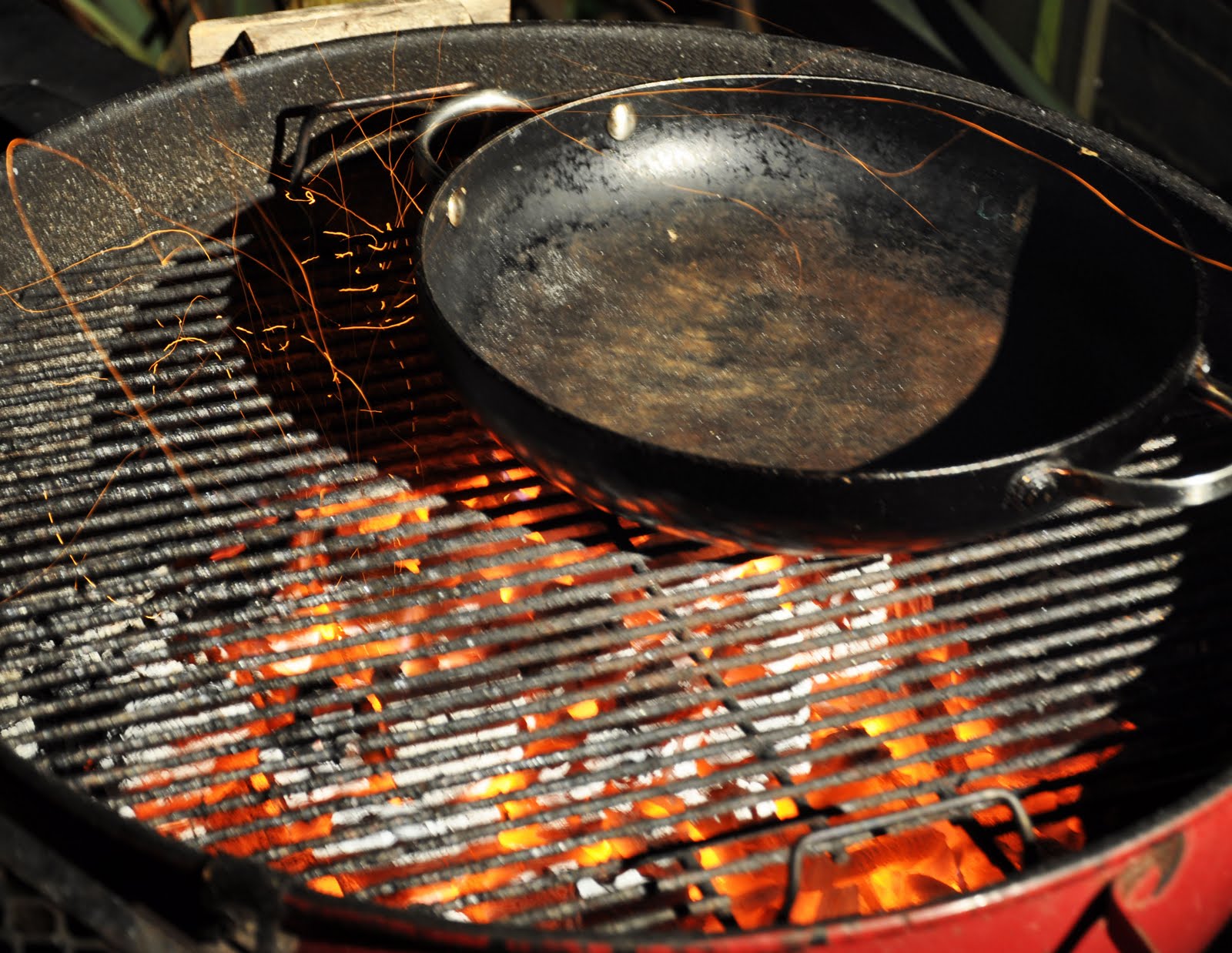
Whilst waiting for the charcoal fire to mature, I rolled out the four flat breads and wrapped them in a tea towel to stop them drying out. As planned the coals were searingly hot in good time so on went the paella pan to heat up for the bread, on on went the skewers. I was constantly moving them about to stop them burning whilst cooking the flat bread and wrapped them in a cloth to keep them warm. The whole thing took just a few minutes, five at the most, and the starter was ready to serve.
I covered the skewers with foil in the hot pan I had used for the bread to keep them warm back in the kitchen whilst the feta, parsley and almond "salad" and tsatsiki were spooned out. I finished off the plate with the hot skewers, pieces of flat bread, a lemon wedge, a single caper berry and a sprinkling of fresh coriander leaves over the chicken.

Needless to say, it went down a treat. The sweet and sour provided by the feta and dates, refreshment from the yoghurt, lemon and mint, and the intense complex flavour of the marinated chicken worked for me. The starter was sufficiently substantial to bridge the 30 minutes or so before the main course would be ready.
For the main course, all there was left to do was steam the broccoli, prepare the cous cous, carve the lamb and serve it up. Using my just sharpened carbon steel Opinel knife, I carved the lamb into thin slices across the grain of the muscle and returned them to the baking dish to keep warm under foil. I put the dish on the hob with a gentle flame to keep the pan juices hot for serving.
The sliced lamb, brocolli, pan juices and harissa were served on to warmed plates and garnished with two roasted tomatoes.

The lamb was not pink (I had left it in a bit longer), but very tender and full of flavour with the anchovy fillets and garlic slivers providing extra little bursts along the way. The harissa? Well I was impressed. Complex flavours from the spice mix, just a bit of bite from the red chilli and all that elevated freshness from the coriander leaves. Unfortunately, I had overcooked the broccoli, which was a shame, but it was all eaten all the same.
After a reasonable break and plenty more wine, my lovely wife served up the pre-prepared cinnamon oranges. Wow, nothing like I have ever had before. Juicy chunks of orange mixed with slivered almonds, finely chopped dates, lemon juice, ground cinnamon and a bit of castor sugar. The refreshing, cleansing effect was a perfect finish to the meal.


 In about 30-40 minutes, there will be two white hot mounds of charcoal. Spread each one out and then place a further 5 or 6 pieces of fuel on top of each side to extend the life of the fire. This fire will be good for up to 3 hours, or even longer if extra fuel is added during cooking time (for cooking a turkey for example). The temperature will relax towards the end which is good for a tender roast.